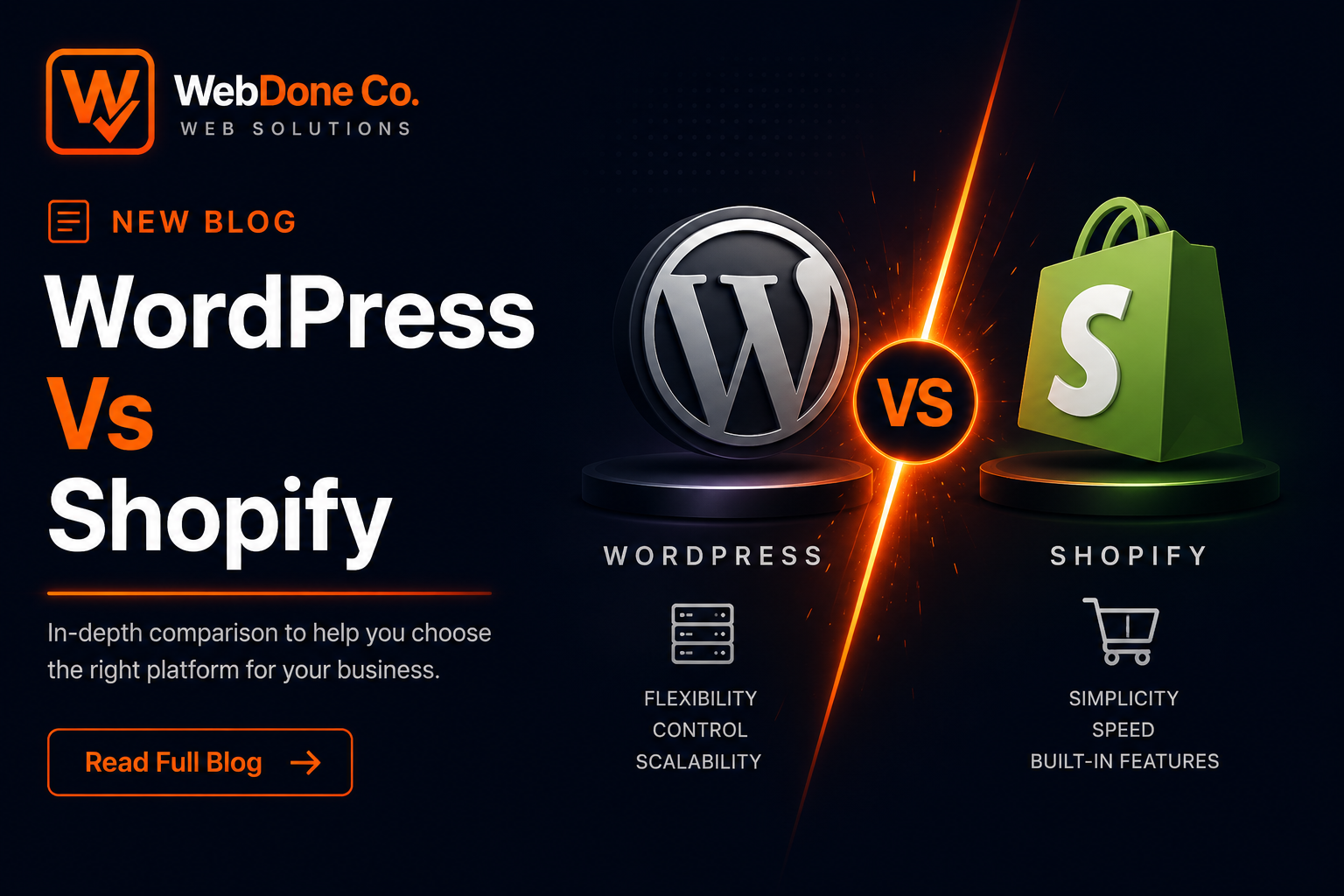
If you're starting a new website project, one of the first questions you'll run into is: WordPress or Shopify? Both are excellent platforms used by millions of businesses worldwide, but they're built for different jobs — and picking the wrong one can cost you time, money, and growth down the line.
The short answer
If you're selling physical products and e-commerce is your primary business, Shopify is usually the better fit. If you need a content-rich site, a blog, or a business that's more than just a store, WordPress gives you far more flexibility.
But the real answer depends on a few specific factors. Let's break them down.
1. What are you actually building?
WordPress started as a blogging platform and has grown into a full content management system. It excels at:
- Business websites with multiple service pages
- Blogs and content-heavy sites
- Membership sites and online courses
- Directories and booking platforms
Shopify, on the other hand, was purpose-built for one thing: selling products online. It excels at:
- Product catalogs with variants (size, color, etc.)
- Secure, PCI-compliant checkout
- Inventory and order management
- Abandoned cart recovery and marketing automation
2. Cost over time
This is where a lot of business owners get surprised. WordPress itself is free and open-source — you own the code outright. Shopify charges a monthly subscription starting around $39/month, which adds up over years.
That said, WordPress isn't entirely free either. You'll typically pay for:
- Hosting (we recommend budgeting $10–25/month for quality hosting)
- Premium plugins for advanced functionality
- Occasional maintenance and updates
For a content site or business website, WordPress is almost always cheaper long-term. For a serious e-commerce store, Shopify's monthly fee is often worth it for the built-in reliability and support.
3. Ease of use
Shopify wins here, hands down. The admin dashboard is clean, intuitive, and built specifically for non-technical store owners. You can add products, manage orders, and run promotions without ever touching code.
WordPress has a steeper learning curve, especially once you start adding plugins for more advanced functionality. However, with a well-built custom theme (which is exactly what we specialize in), the day-to-day experience of managing content can be just as simple.
4. SEO and content marketing
If content marketing and blogging are core to your growth strategy, WordPress is the clear winner. Its content tools are simply more mature — better category structures, more flexible URL handling, and a massive ecosystem of SEO plugins like Yoast and RankMath.
Shopify has improved its blogging features over the years, but it's still secondary to its core e-commerce functionality. If SEO-driven content is a priority, we often recommend a hybrid approach: Shopify for the store, with a WordPress blog feeding traffic back to it.
5. Scalability
Both platforms scale well, but differently. Shopify scales seamlessly for traffic spikes — Black Friday, viral moments, and seasonal surges are handled automatically since Shopify manages the infrastructure.
WordPress scaling depends entirely on your hosting setup. With the right hosting and caching strategy (which we configure on every project), WordPress sites handle significant traffic without issue. It just requires more upfront planning.
So, which should you choose?
Here's our honest, no-sales-pitch breakdown:
Choose Shopify if:
- E-commerce is your primary or only business
- You want the simplest possible day-to-day management
- You don't want to think about hosting, security, or updates
Choose WordPress if:
- You need a content-rich site, blog, or service-based business
- You want full ownership of your code with no monthly platform fee
- You need custom functionality that goes beyond a standard store
Still not sure? That's completely normal — most of our clients aren't sure either when they first reach out. We offer a free consultation where we walk through your specific business goals and budget, then recommend the platform that actually fits, not the one that's easiest for us to sell.
Get in touch and let's figure out the right approach for your project.
Need Help With Your Website?
We build fast, modern websites that actually drive results. Get a free consultation and a fixed-price quote.